
Beralih ke bagian utama
Beranda > Terbitan > Vol 12 No 1 (2026) > Analysis of the implementation of good governance principles in the mandatory B30 biodiesel program in Indonesia
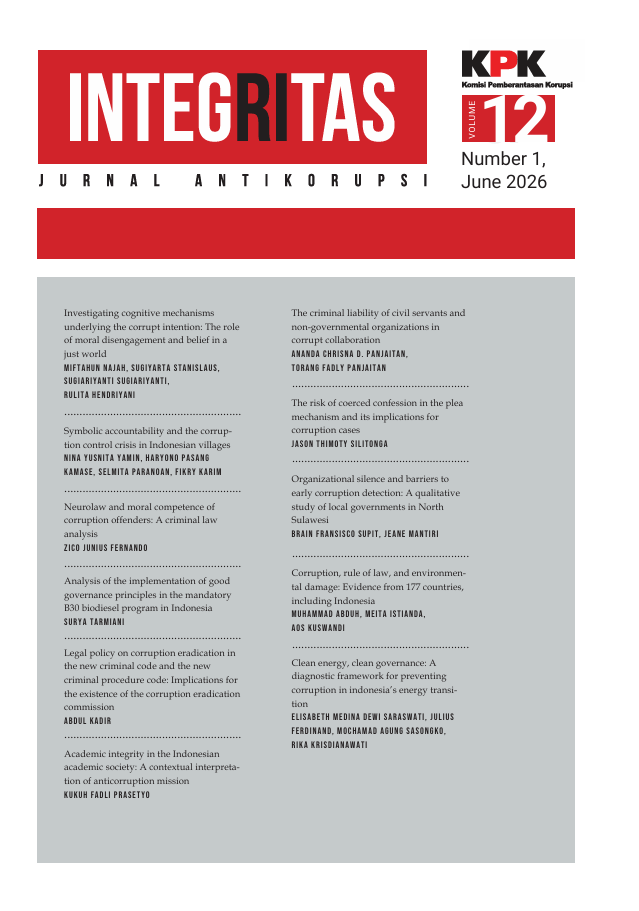
ARTIKEL PENELITIAN Edisi: Vol 12 No 1 (2026) | Rilis: 2026-06-24

Analysis of the implementation of good governance principles in the mandatory B30 biodiesel program in Indonesia

ABSTRAK

The mandatory biodiesel policy is one of the Indonesian government's main strategies to achieve the 23% renewable energy mix target by 2025 and reduce greenhouse gas emissions. However, the biodiesel subsidy policy faces challenges such as potential inefficiency, lack of transparency, and corruption risks. This study aims to analyze the implementation of good governance principles in the mandatory B30 biodiesel program and identify influencing factors. The study was conducted using a qualitative approach through in-depth interviews with sources from the Ministry of Energy and Mineral Resources, BPDPKS, Aprobi, and a review of regulatory documents and audit reports. The results show that although the B30 program provides significant benefits in terms of foreign exchange savings, domestic CPO absorption, and emission reductions, weaknesses remain in aspects of accountability, transparency in market index pricing, and the imposition of sanctions on business entities that do not meet distribution quotas. This study's recommendations include increasing the transparency of the biodiesel HIP formula, strengthening the subsidy distribution verification mechanism, and imposing strict sanctions to encourage business entity compliance. This research contributes to the energy governance literature and can serve as a reference for the formulation of more effective and sustainable biodiesel subsidy policies.

KATA KUNCI

good governance biodiesel subsidies energy governance B30

TIM PENULIS & BIOGRAFI PENULIS

Surya Tarmiani

, Universitas Gadjah Mada

Universitas Gadjah Mada, Yogyakarta, Indonesia

DAFTAR PUSTAKA (REFERENCES)

Amanta, F., & Nafisah, N. (2022). Produktivitas kelapa sawit tetap terbatas seiring melonjaknya harga minyak goreng di Indonesia. https://doi.org/10.35497/355798 Creswell, J. W. (2014). Research design: qualitative, quantitative, and mixed methods approaches. SAGE Publications,. GAPKI. (2022). Kinerja industri sawit 2021 & prospek 2022. GAPKI. Halimatussadiah, A., Siregar, A. A., Moeis, F. R., & Maulia, R. F. (2020). Risiko kebijakan biodiesel dari sudut pandang indikator makroekonomidan lingkungan. Lembaga Penyelidikan Ekonomi dan Masyarakat Fakultas Ekonomi dan Bisnis – Universitas Indonesia. Kaufmann, D., & Kraay, A. (2025). The worldwide governance indicators : Methodology and 2024 update. SSRN Electronic Journal, 58. https://doi.org/10.2139/ssrn.5154675 Khatiwada, D., Palmén, C., & Silveira, S. (2021). Evaluating the palm oil demand in Indonesia: production trends, yields, and emerging issues. Biofuels, 12(2), 135–147. https://doi.org/10.1080/17597269.2018.1461520 Sovacool, B. K., Mullard, S., & Ceballos, J. C. (2024). “Made for corruption?” Private sector actors, renewable energy, and corruption risks for wind power in Mexico and solar electricity in Kenya. The Electricity Journal, 37(7–10), 107448. https://doi.org/10.1016/j.tej.2024.107448 Thompson, N. A., Herrmann, A. M., & Hekkert, M. P. (2015). How sustainable entrepreneurs engage in institutional change: insights from biomass torrefaction in the Netherlands. Journal of Cleaner Production, 106, 608–618. https://doi.org/10.1016/j.jclepro.2014.08.011

LISENSI DAN HAK CIPTA

Lisensi Terbuka Creative Commons Attribution-ShareAlike 4.0 International License (CC BY-SA 4.0)

Karya jurnal ini dipublikasikan secara terbuka untuk publik dan dilindungi di bawah lisensi Creative Commons Attribution-ShareAlike 4.0 International License.


CARA MENGUTIP (HOW TO CITE)

Tarmiani, S. (2026). Analysis of the implementation of good governance principles in the mandatory B30 biodiesel program in Indonesia. Integritas: Jurnal Antikorupsi, 12(1), 43-56. https://doi.org/10.32697/integritas.v12i1.1629

TERINDEKS OLEH: