Beralih ke bagian utama
Beranda > Terbitan > Vol 12 No 1 (2026) > Legal policy on corruption eradication in the new criminal code and the new criminal procedure code: Implications for the existence of the corruption eradication commission
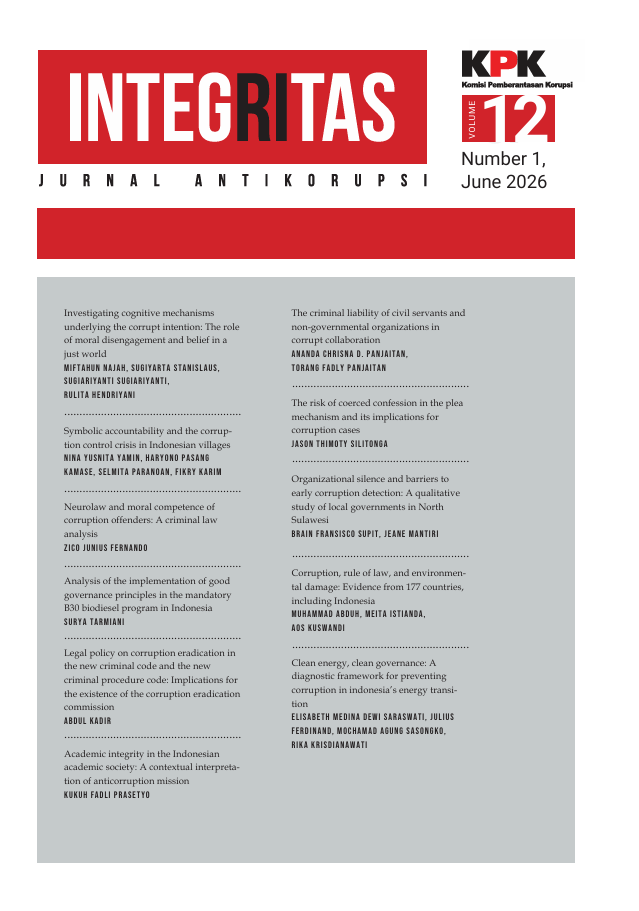
ARTIKEL PENELITIAN Edisi: Vol 12 No 1 (2026) | Rilis: 2026-06-24

Legal policy on corruption eradication in the new criminal code and the new criminal procedure code: Implications for the existence of the corruption eradication commission

ABSTRAK

The update of the Criminal Code (KUHP) and the Criminal Procedure Code (KUHAP) is part of Indonesia’s national legal reform that affects the anti-corruption system, particularly the authority of the Corruption Eradication Commission (KPK). This study aims to analyze the position of corruption offenses within the national criminal law system following the enactment of the new KUHP and KUHAP, as well as to examine their implications for the KPK’s authority. The research employs a normative legal method using statutory, conceptual, and legal policy approaches through the analysis of relevant legal norms and legislative policies. The findings indicate that corruption offenses remain classified as special crimes (lex specialis) and extraordinary crimes, with their regulation continuing to be governed by special legislation outside the KUHP. The KUHP functions as a general criminal law regulating legal principles, criminal liability, and sentencing systems, while the KUHAP provides a procedural framework that places greater emphasis on the protection of human rights and the principles of due process of law. The reform of the KUHAP also requires adjustments to the KPK’s authority within the framework of an integrated criminal justice system without eliminating the special character of anti-corruption enforcement. Therefore, harmonization between general criminal law and special criminal law is necessary to maintain effectiveness, accountability, and justice in combating corruption in Indonesia.

KATA KUNCI

Politik Hukum Pemberantasan Korupsi KUHP Baru KUHAP Baru KPK

TIM PENULIS & BIOGRAFI PENULIS

Abdul Kadir

, Universitas Muhammadiyah Tangerang
Universitas Muhammadiyah Tangerang

DAFTAR PUSTAKA (REFERENCES)

Abdullah, S. (2011). Korupsi, pidana mati dan hak azazi manusia dalam perspektif sistem pidana. Lex Specialist, 13, 59–69. Adji, I. S. (2009). Korupsi dan penegakan hukum. Diadit Media. Al-Fatih, S., Thahir, P. S., & Ghapa, N. (2025). Criminalization of teachers due to case of bullying committed by students. IJCLS (Indonesian Journal of Criminal Law Studies), 10(2), 379–416. https://doi.org/10.15294/ijcls.v10i2.21014 Amiruddin, Z. A. (2018). Pengantar metode penelitian hukum. RajaGrafindo Persada. Arief, B. N. (2011a). Kebijakan Hukum Pidana. Kencana. Arief, B. N. (2011b). Pembaharuan hukum pidana dalam perspektif kajian perbandingan. Citra Aditya Bakti. Atmasasmita, R. (2006). Korupsi, good governance, dan komisi anti korupsi di Indonesia. Badan Pembinaan Hukum Nasional. Atmasasmita, R. (2010). Teori dan kapita selekta kriminologi. Refika Aditama. Carina, H. P. (2025). KUHAP Baru Disahkan, Ketua KPK Harap Kewenangannya Tak Berubah. Compas.Com. https://doi.org/https://nasional.kompas.com/read/2025/11/19/09572741/kuhap-baru-disahkan-ketua-kpk-harap-kewenangannya-tak-berubah Chazawi, A. (2016). Hukum pidana khusus: Tindak pidana korupsi. RajaGrafindo Persada. Djaja, E. (2010). Memberantas korupsi bersama KPK, Komisi Pemberantasan Korupsi: kajian yuridis normatif UU nomor 31 tahun 1999 juncto UU nomor 20 tahun 2001 versi UU nomor 30 tahun 2002. Sinar Grafika. Hadi, N. A. K. (2022). Penegakan hukum di Indonesia dilihat dari perspektif sosiologi hukum. Jurnal Hukum Dan Pembangunan Ekonomi, 10(2), 227. https://doi.org/10.20961/hpe.v10i2.62834 Hamzah, A. (2014). Pemberantasan korupsi melalui hukum pidana nasional. RajaGrafindo Persada. Hamzah, A. (2015). Pemberantasan korupsi melalui hukum pidana nasional. Raja Grafindo Persada. Hamzah, A. (2016). Pemberantasan korupsi melalui hukum pidana nasional dan internasional. Rajawali Pers. Harahap, M. Y. (2015). Pembahasan permasalahan dan penerapan KUHAP. Sinar Grafika. Hiariej, E. O. S. (2016). Prinsip-Prinsip Hukum Pidana. Cahaya Atma Pustaka. Hiariej, E. O. S. (2023). Anotasi KUHP Nasional. Prenadamedia Group. Indriati, T., Rizkiah, N., & Mazhar, M. N. M. (2025). Recodification of corruption crime provisions in the national criminal code. Integritas: Jurnal Antikorupsi, 10(2), 239–248. https://doi.org/10.32697/integritas.v10i2.1152 Komisi Pemberantasan Korupsi. (2025). Laporan tahunan KPK 2024. Mahfud MD. (2012). Politik hukum di Indonesia. Rajawali Pers. Marzuki, P. M. (2007). Penelitian hukum. Kencana. Muladi, M. (2008). Lembaga pidana bersyarat. Alumni. Muqoddas, B. (2015). Menjaga api pemberantasan korupsi. PUSHAM UII. Nomor 012-016-019/PUU-IV/2006, Pertimbangan Hukum (2006). Nugraha, R. S., Rohaedi, E., Kusnadi, N., & Abid, A. (2025). The transformation of Indonesia’s criminal law system: Comprehensive comparison between the old and new penal codes. Reformasi Hukum, 29(1), 1–21. https://doi.org/10.46257/jrh.v29i1.1169 Nurwantoko, E. (2025). Corruption in the new criminal code: legal reforms and implications. International Journal of Progressive Sciences and Technologies, 49(1), 496–506. https://doi.org/10.52155/ijpsat.v49.1.7038 Rahaditya, R. (2024). Hukum acara pidana (U. Zanariyah (ed.)). Literasi Nusantara Abadi. Rahardjo, S. (2011). Hukum progresif: Hukum yang membebaskan. Jurnal Hukum Progresif, 1(1), 1–24. https://doi.org/10.14710/hp.1.1.1-24 Soekanto, S., & Mamudji, S. (2011). Penelitian hukum normatif: Suatu tinjauan singkat. RajaGrafindo Persada. Sofyan, A. M., & Azisa, N. (2016). Hukum acara pidana. Prenadamedia Group. Sudarto, S. (1986). Hukum dan hukum pidana. Alumni. Syah, Z. A. (2025). Laporan hasil pemantauan tren korupsi tahun 2024 (A. G. P. Sjafrina & W. Alamsyah (eds.)). Indonesia Corruption Watch. Transparency International. (2024). Corruption perceptions index.

LISENSI DAN HAK CIPTA

Lisensi Terbuka Creative Commons Attribution-ShareAlike 4.0 International License (CC BY-SA 4.0)

Karya jurnal ini dipublikasikan secara terbuka untuk publik dan dilindungi di bawah lisensi Creative Commons Attribution-ShareAlike 4.0 International License.

CARA MENGUTIP (HOW TO CITE)

Kadir, A. (2026). Legal policy on corruption eradication in the new criminal code and the new criminal procedure code: Implications for the existence of the corruption eradication commission. Integritas: Jurnal Antikorupsi, 12(1), 57-76. https://doi.org/10.32697/integritas.v12i1.1664

TERINDEKS OLEH: