Home > Issues > Vol. 11 No. 2 (2025) > Analysis of corruption risk and prevention efforts based on the perceptions of public service users in Merauke Regency
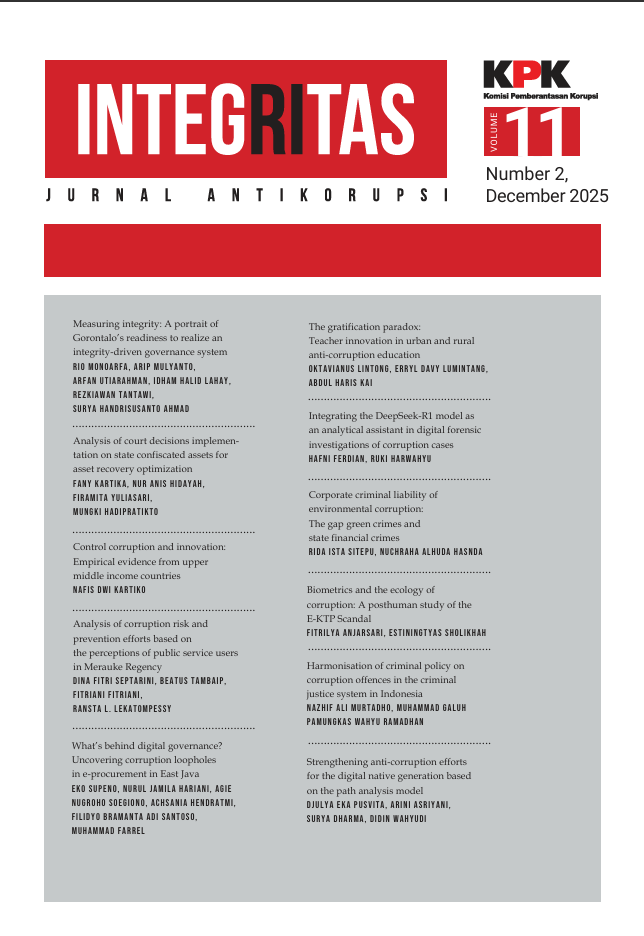
RESEARCH ARTICLE Issue: Vol. 11 No. 2 (2025) | Published: 2025-12-21

Analysis of corruption risk and prevention efforts based on the perceptions of public service users in Merauke Regency

1 Universitas  Musamus
2 Universitas Musamus
3 Universitas  Musamus
4 Universitas  Musamus
Downloads
277
Views
208
Citations
16

ABSTRACT

Corruption in local government in Indonesia, particularly in Merauke Regency, South Papua Province, undermines public trust and development. This study maps corruption risks from the perspective of service users, measures the impact of prevention, and develops recommendations through the 2024 KPK SPI, integrating Principal-Agent, Institutional, Collective Action, and Social Capital theories. Method: Quantitative (191 external respondents in 63 OPDs via CAPI), validated qualitatively (interviews with 9 key informants). Results: SPI score of 65.16 (highest in South Papua, national average), zero prevalence of corruption. Structural-geographical risks in remote districts (information asymmetry, unequal access, weak supervision). Positive (70% improvement) but asymmetrical impact of prevention measures (Integrity Zone, MCP, e-procurement). Recommendations from this study include the establishment of mobile Integrated Service Posts, community supervision, inclusive digitalization, and local culture training. Contribution: A bottom-up prevention model for WBK/WBBM and data-driven autonomous governance reform.

KEYWORDS

Risk of Corruption SPI Prevention Effectiveness Integrity Merauke

AUTHORS & AUTHOR BIOGRAPHY

Beatus Tambaip

, Universitas  Musamus

Jurusan Administrasi Negara, Universitas  Musamus, Indonesia

Dina Fitri Septarini

, Universitas Musamus

Jurusan Akuntansi, Universitas  Musamus, Indonesia

Fitriani Fitriani

, Universitas  Musamus

Jurusan Administrasi Negara, Universitas  Musamus, Indonesia

Ransta L. Lekatompessy

, Universitas  Musamus

Jurusan Administrasi Negara, Universitas  Musamus, Indonesia

REFERENCES

Adeyemi, O. O., & Oluwatobi, A. (2019). Local government administration in nigeria: a historical perspective. Journal of Public Administration and Governance. Agerberg, H. (2023). The challenges in the anti-corruption efforts by the government agencies in Southeast Asia. International Journal of Academic Research in Business and Social Sciences, 13(18). Akçay, S. (2024). Corruption and human development. Cato Journal, 26(1). Bauhr, M., & Charron, N. (2023). “It’s the quality of government stupid” explaining patterns in support for far right in the 2022 French presidential election. Electoral Studies, 84 , 102644. Graycar, A., & Monaghan, B. (2024). The cultural theory of corruption. Edward Elgar Publishing. Li, H., Silv-Atencio, G., & others. (2024). Blockchain-enabled anti-corruption frameworks for public procurement: A Latin American case study. European Alliance for Innovation. Pieth, M. (2025). Collective Action: Innovative Strategies to Prevent Corruption. Basel Institute on Governance. Putnam, R. D. (2000). Bowling alone: The collapse and revival of American community. Simon & Schuster. Sari, I. H., & others. (2022). The effect of the government internal control system on corruption potential with accountability as an intervening variable. International Journal of Education and Management Engineering, 11(1). Thompson, D. F. (2018). Theories of institutional corruption. Annual Review of Political Science, 21, 1–19. United Nations Office on Drugs and Crime. (n.d.). Module 4: Theories that explain corruption. https://www.unodc.org/e4j/en/anti-corruption/module-4/key-issues/theories-that-explain-corruption.html Law of the Republic of Indonesia Number 7 of 2006 concerning Ratification of the United Nations Convention Against Corruption, 2003 (United Nations Convention Against Corruption, 2003). (2006). State Gazette of the Republic of Indonesia of 2006 Number 32. Law of the Republic of Indonesia Number 19 of 2019 concerning the Second Amendment to Law Number 30 of 2002 concerning the Corruption Eradication Commission. (2019). State Gazette of the Republic of Indonesia of 2019 Number 202. Law of the Republic of Indonesia Number 14 of 2022 concerning the Establishment of South Papua Province. (2022). State Gazette of the Republic of Indonesia Year 2022 Number 148. United Nations Office on Drugs and Crime. (2025). Module 4: Theories that explain corruption. In UNODC Anti-Corruption Module Series. Retrieved November 22, 2025, from https://www.unodc.org/e4j/en/anti-corruption/module-4/key-issues/theories-that-explain-corruption.html Musamus University. (2024). Qualitative report on the 2024 KPK integrity assessment survey (SPI) for Merauke, Boven Digoel, Mappi, and Asmat Regencies. Musamus University.

LICENSE AND COPYRIGHT

Open Access Creative Commons Attribution-ShareAlike 4.0 International License (CC BY-SA 4.0)

This work is published open-access and licensed under a Creative Commons Attribution-ShareAlike 4.0 International License.

HOW TO CITE

Tambaip, B., Septarini, D. F., Fitriani, F., & Lekatompessy, R. L. (2025). Analysis of corruption risk and prevention efforts based on the perceptions of public service users in Merauke Regency. Integritas: Jurnal Antikorupsi, 11(2), 219-226. https://doi.org/10.32697/integritas.v11i2.1490

INDEXED BY: