
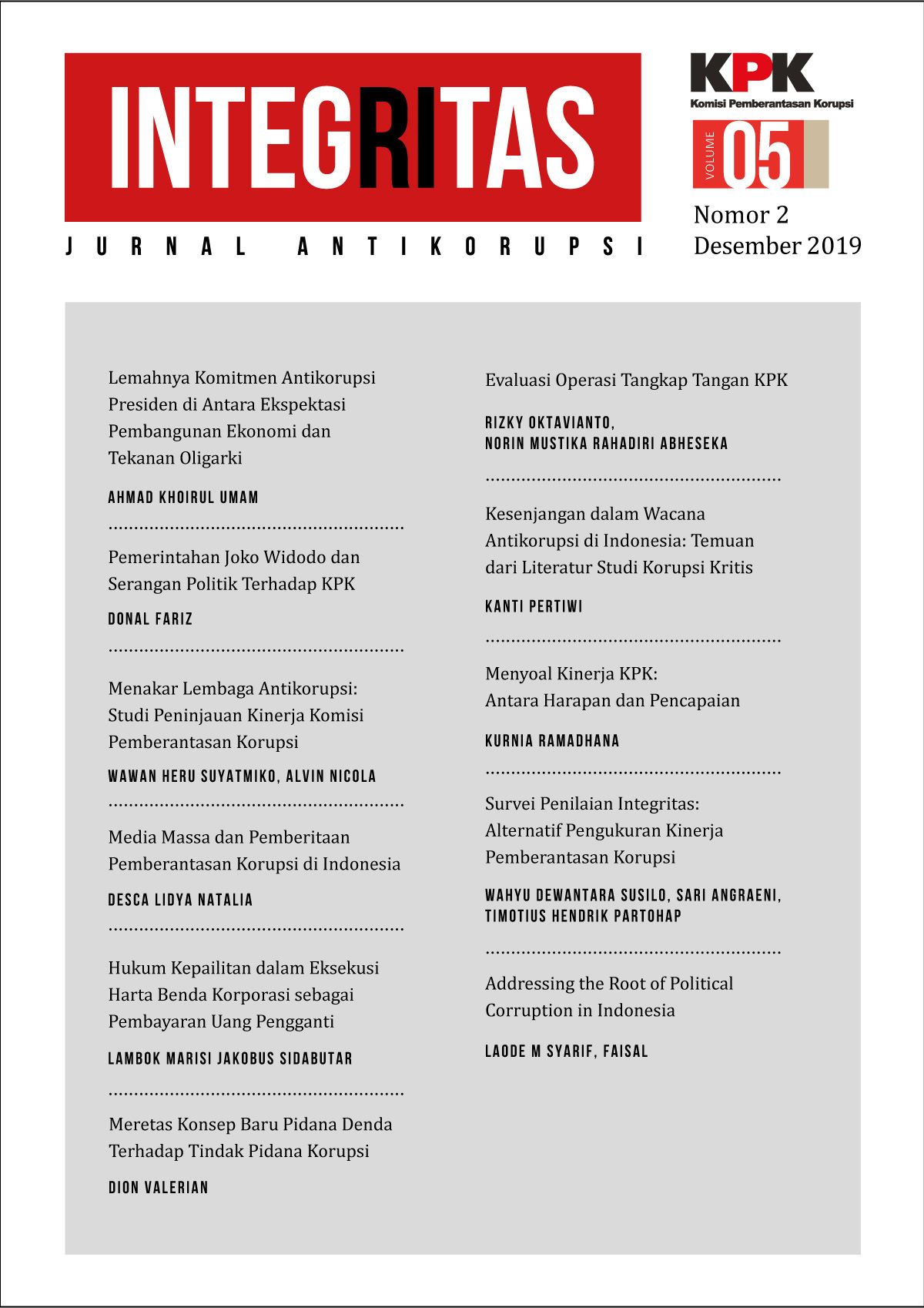
Media Massa dan Pemberitaan Pemberantasan Korupsi di Indonesia
ABSTRACT
The purpose of this paper is to explain the role of mass media in Indonesia in framing public perceptions regarding the eradication of corruption and how the public's perception of the works in combating corruption and corruption itself. The finding is although press acts as the watchdog of the state particularly by conducting investigative reporting about corruption so that it exists to perform check and balance for the public offices, the press cannot simply reduce corruption's rate. The reasons are the lack of public's memories, the weak link of press exposure and policy changes, state versus capital interest in the newsroom, and the bias in reporting corruption. As a result, even though the public considers corruption as a serious problem but they don't take part in eradicating corruption and let KPK or other law enforcers do the work. Legal and regulatory environment that allows the media to be an effective watchdog is needed as well as raising professional and ethical standards for the journalists.
KEYWORDS
AUTHORS & AUTHOR BIOGRAPHY
Desca Lidya Natalia
, AntaraREFERENCES
LICENSE AND COPYRIGHT

Open Access Creative Commons Attribution-ShareAlike 4.0 International License (CC BY-SA 4.0)
This work is published open-access and licensed under a Creative Commons Attribution-ShareAlike 4.0 International License.