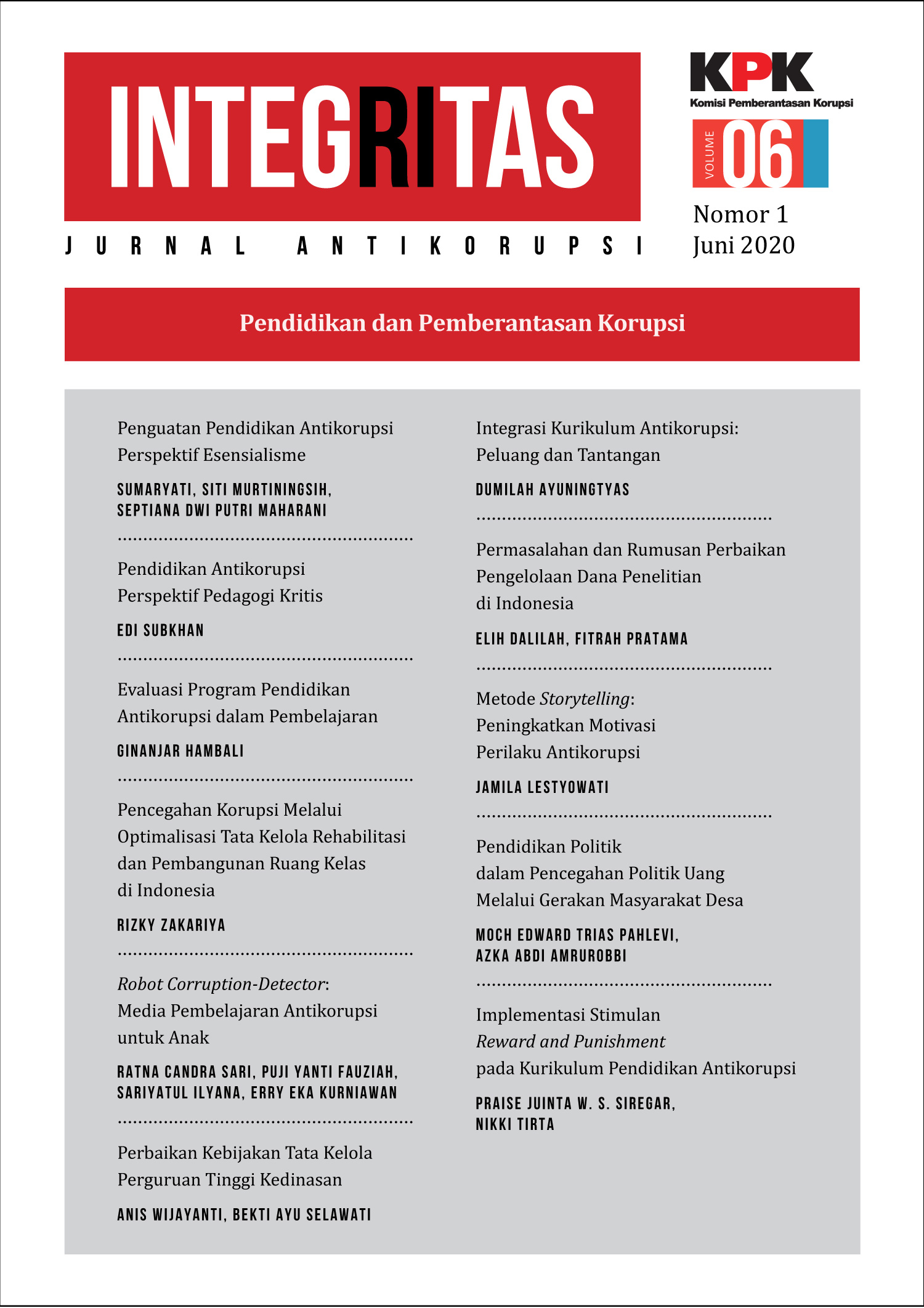
Implementasi Stimulan Reward and Punishment pada Kurikulum Pendidikan Antikorupsi
ABSTRACT
Education is one of the important aspects in preventing corruption. However, an educational curriculum without a cooperative community culture will never have a serious impact. The formation of this culture needs stimulation, and in this article we offer the concept of George Homans' Social Behavior and George Herbert Mead's Symbolic Interactionist as an alternative approach to the problem at hand. This study uses a qualitative methodology through a literature study approach. Our hypothesis is the lack of rewards for individuals who dare to be anticorruption is one of the causes of the lack of culture that is built up in the community. Those who dare to uphold anti-corruption basic values often get pressure from peer groups. This gives a negative stimulant for the implementation of anti-corruption values.
KEYWORDS
AUTHORS & AUTHOR BIOGRAPHY
Praise Juinta W S Siregar
, Komisi Pemilihan UmumNikki Tirta
, University of IndonesiaREFERENCES
LICENSE AND COPYRIGHT

Open Access Creative Commons Attribution-ShareAlike 4.0 International License (CC BY-SA 4.0)
This work is published open-access and licensed under a Creative Commons Attribution-ShareAlike 4.0 International License.